
The position of Genesis on the nature of who we are as men and women is often summed up through the following passages:
“So God created humankind in his image,
in the image of God he created them” [Gen. 1:27].
“… then the Lord God formed man from the dust of the ground, and breathed into his nostrils the breath of life” [Gen. 2:4].
The standard[1] taught implication of these two passages is that what is transmuted through God’s breath to Adam is not only life, but a certain power; a God-like essence, which implies that we are the apex of God’s creation; little Gods, in a sense, free to do our biddings as we see fit. After all, how can anybody argue against this? It is to be found right in the Bible, we are granted ‘dominion’ over the earth:
“Then God said, ‘Let us make humankind in our image, according to our likeness, and let them have dominion over the fish of the sea, and over the birds of the air, and over the cattle, and over all the wild animals of earth, and over every creeping thing that creeps upon earth’” [Gen. 1:26].
Perhaps this is not entirely the case.
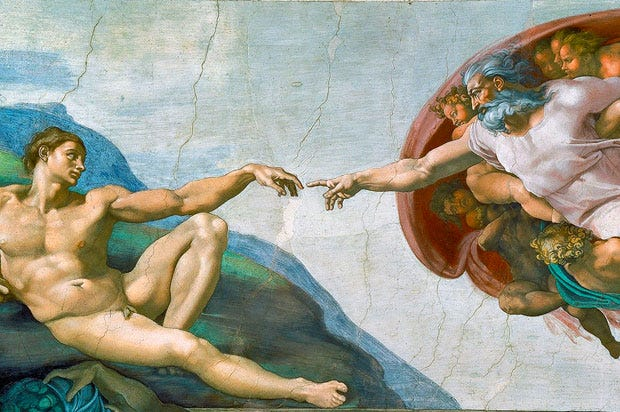
The aim of this paper is to examine the misconceptions behind such interpretations as well as deepen the implications behind what it means to be inspired by God’s breath. Above this, being informed from lectures with Mark Glouberman, this paper attempts to expand on a deeper conceptual meaning — a message that may have been drowned out in contemporary and popular interpretations. Finally, the fundamental concepts this paper discusses will be considered in context to their contributions to Western morality and ethics.
A Dominion unto Itself
The standard interpretation of Genesis includes a murky understanding of dominion that is often supported by the aforementioned quotation. Humanity being granted dominion is commonly understood as God granting us ownership of his creation to do with as we see fit – yet in the context of the text in Genesis itself, this interpretation isn’t entirely accurate. In Genesis 2, Adam is created by God to “till and keep” the Garden of Eden [Gen. 2:15]. As long as Adam obeys God’s rules, he will be taken care of (and will be spared death). This is not technically what is commonly understood as unrestrained dominion over the planet. It is more akin to being a domesticated carthorse being kept as long as it fulfills its purpose. To further note, God also limits the breadth of human dominion in Genesis 1 by stating, “I have given every green plant for food” [Gen 1:30] which implies that the animals of creation are not to be consumed by Adam.
It is easy to see how upon this myopic interpretation of dominion that the idea of God allowing us to become ‘little Gods’ can be easily constructed. This, which is a position put forth by Glouberman as well as this paper, is evidently not what is supported by the text.
Neither is monotheism in its modern understanding, for the matter. What is implied with God as a deity being distinct from the natural world (insofar as to be the agent that creates it) is that, in many ways, God is devoid from — literally separated off — the natural system. In Deuteronomy 6:4, the Shema states “Hear, O Israel: the LORD our God, the LORD is one” [Deut. 6:4]. This quotation is very commonly understood and echoed throughout Abrahamic religions in its teachings as a championing of monotheism over the pagan belief structure of the past.
A closer reading proves that this is not what the text actually says, though. Clearly[2], the text states that God is ‘one,’ not that there is solely one god. This tiny, often over-looked, distinction has powerful implications.
In regards to opinions against the matter, Genesis puts forward no arguments for the existence of only one god nor for the disproval of others. Pagan gods represent aspects of nature, and the authors would be hard-pressed to argue against the existence of Zeus, Poseidon, or Aphrodite as they were commonly known only as the personifications and idealizations of real forces of nature (lightning, water, and love, respectively).
How, then, do the Pagan gods of Greece or Rome differ from the God of the Bible? The answer lies in their natural constitutions and domains. The pagan gods are part of nature; they exist firmly within it. They are continuously acting and reacting to actions of other gods; scheming, worrying, plotting –each one is a part of an ordered system that when permutated, affects the rest of its counterparts. God, on the other hand, is, wholly unnatural and, as mentioned above, precisely defined as one; a particular. Even though he, “the LORD, God Most High, maker of heaven and earth” [Gen 14:22] created it, he is not a product of nature.
This particularity is interesting because it is an idea that isn’t truly exhibited in nature. One can go so far as to saying that particularity, much like the idea of nothingness, is a purely philosophical construct wholly devised by the human mind. Furthermore, this idea is a novel concept in religions of the era. While monotheistic religious structures were attempted previously (Akhenaton’s attempt to abandon Egypt’s polytheistic belief systems in favour for worship centered on Aten, the sun god [Dorman, n.d.]), a deity that is separate of the nature it embodies is completely innovative.
This notion becomes much more defined when it is understood that God, who is a deity that is devoid of the system that he is a part of, actually has no dominion in nature. This is the underlying message that the authors behind Genesis intend to communicate through the text; that much like human beings, God doesn’t seem to have a place in the natural world. God is an isolated singularity; autonomous; affected by, but not dependent upon the established system of nature.
It is this powerful idea of particularity that God breathes into Adam’s nostrils. This is the hidden message that has been drowned out by contemporary understandings of Genesis. The authors are using God’s conceptual physicality to explain to the reader that much like God, what humans possess is an extraordinary separateness from nature. Similar to the nature of God, each person is its own separate system, or actor, with its own drives and aspirations. While nature does act upon us, and we are derived of nature, human beings aren’t entirely natural in the sense that we have a separate drive that is not based on nature’s laws or forces. In simpler words, we possess free will. Unlike the fish in the sea, and the birds in the air, humans, like God, lack a dominion. In a lot of ways, this means humanity can have the power to choose and question, even create, these domains.
Being imbued with God’s particularity elucidates a much deeper philosophical question in regards to what it means to be a person. This solidified concept of particularity did not exist prior to Genesis and feeds into the accepted Western moral axiom of every human life possessing some intrinsic value.
Without this notion of particularity (oneness), one cannot come to the conclusion that there is value in the individual. Without this distinction, it is very difficult to fabricate a conceptual roadmap that explains value being intrinsic to the individual that isn’t a product derived from being a part of a larger system. It is in the formulation of these concepts where Genesis triumphs over paganism and the Homeric early glimpses into human suffering. Endowed with this idea, this concept has played a role in moving Western societies along to develop deep moral codes, ethical systems, and even ideas towards the concept of morality itself. Pagans could certainly behave morally, but without a clear definition of oneness, they lacked the conceptual framework, or tools, to fully understand these abstractions or to contribute any clarity towards their ossification as philosophical constructs and theories as they exist in their contemporary forms. In closing, we have come to a clearer understanding of the intended implications in Genesis of having Adam, and by extension, all of humanity, being constructed in God’s image: the self-awareness that we, as creatures of creation, seem to possess the unique trait of individuality. This concept is communicated in Genesis through the dramatization of God, an abstract concept separate from the system it affects, breathing his essence into Adam’s nostrils, implicitly imparting some of this individuality into humanity.
We have come to this understanding by ways of deconstructing some of the misconceptions of standard and popular interpretations of key passages in Genesis and First Testament scripture along with further clarifications of the distinct concepts of God’s dominion and particularity.
Finally, it is in this conceptual idea of the transference of God’s very particular essence that has contributed to a sharpening of the concepts of individuality, the intrinsic value of the individual and has fundamentally enriched the developments of morality, ethics, and philosophical concepts in the Western world.
References
Metzger, B. M., & Murphy, R. E. (1991). The new Oxford annotated Bible with the Apocryphal/Deuterocanonical books. New York: Oxford University Press.
Deuteronomy. (n.d.). In Mechon Mamre. Retrieved August 1, 2014, from http://www.mechon-mamre.org/p/pt/pt0506.htm#4
Dorman, P. F. (n.d.). Akhenaton (king of Egypt). Retrieved August 2, 2014, from http://www.britannica.com/EBchecked/topic/11544/Akhenaton
[1] Standard being in the sense of what is often taught in Sunday schools and discussed as common knowledge in conversations revolving around the creation according to Genesis.
[2] This is supported as well in the original Aramaic and Jewish text.